A drone hangar is an automated docking station that allows a UAV to launch, recover, recharge or swap batteries, and transmit data without personnel on site. For security and counter-UAS procurement teams, the practical question is not whether automation is useful, but which hangar system can integrate with your command infrastructure, keep operating through network and power disruptions, and carry the surveillance payload your threat model requires. This FAQ answers the questions procurement teams most often ask when evaluating drone hangars, using the Vertical takeoff and landing fixed-wing unmanned aerial vehicle automatic hangar (model UK-01) from UING Intelligence Technology as a worked example.
What does a drone hangar actually do, and when does it justify the investment?
A drone hangar converts a UAV from a manually flown tool into an automated, remotely managed asset. The UK-01, for example, supports one-button automatic takeoff, automatic recovery, and automatic fast battery swapping and charging, with cloud control and management included. In a security context, this means scheduled or event-triggered patrols of perimeters, ports, critical infrastructure, or large industrial sites can run without a crew standing by at the airfield.
The investment typically makes sense when patrols are frequent, the site is large or remote, and response time matters. If your operation only flies occasionally, or a human crew is already on site, a hangar may add cost without proportional benefit. Procurement teams should map patrol frequency, site area, and staffing before committing to any automated docking system.
Which use cases in security and counter-UAS operations fit an automated hangar?
Based on the capabilities documented for systems in this category, hangar-based drones are commonly evaluated for:
- Perimeter and fence-line patrol of critical infrastructure, logistics yards, and energy sites, using automated scheduled flights.
- Rapid situational awareness on alarm triggers, where the drone launches automatically and streams live video to a control room.
- Wide-area surveillance, where fixed-wing endurance outperforms multirotor platforms. The UK-01 offers 3 hours of endurance at a 72 km/h economic cruise speed with a 4,500 m practical service ceiling.
- Night and low-visibility monitoring using dual optical payloads; the UK-01's payload combines visible light at 1920x1080 resolution with infrared at 640x512 resolution.
- Long-range data relay from the aircraft to ground stations, supported by the UK-01's integrated broadband wireless link with optional 50 km, 100 km, or 150 km range configurations.
Note that a hangar-mounted surveillance drone supports counter-UAS programs by providing aerial monitoring of approach routes and airspace activity. It is not itself a detection or jamming system; counter-UAS detection and countermeasure equipment is a separate procurement category.
How does a hangar integrate with existing security and command infrastructure?
Integration questions should be answered from the supplier datasheet, not from assumptions. For the UK-01, the documented integration points are: cloud control and management for remote tasking and monitoring; a network architecture supporting wired, 4G, 5G, or mesh networking with customization available; and an integrated video and data broadband wireless link between aircraft and ground. Compatibility with three types of operational environments is stated, but the specific environment definitions are not detailed in the summary data, so contact us for the datasheet.
One specification deserves particular attention from security buyers: resilience during power loss. The UK-01 is documented to continue running for 5 hours after hangar power is cut off. For sites where adversaries may target infrastructure, or where grid reliability is a concern, ask every supplier how their system behaves during a power outage and what backup duration is specified.
Which specifications matter most when evaluating a hangar system?
Procurement teams should build a specification matrix covering the hangar itself, the aircraft, the payload, and the communications chain. The table below shows the documented specifications of the UK-01 as an example of what to request from any supplier.
| Attribute | UK-01 (documented) |
|---|---|
| Hangar type | Automatic hangar for VTOL fixed-wing (hybrid wing) UAV |
| Hangar weight | 1,500 kg |
| Automation | One-button automatic takeoff, automatic recovery, automatic fast battery swapping and charging |
| Management | Cloud control and management |
| Network | Wired / 4G / 5G / mesh (customizable) |
| Power-loss resilience | Continues running 5 hours after hangar power is cut off |
| Aircraft dimensions | Wingspan 268 cm, length 165 cm, height 68 cm |
| Endurance / cruise speed | 3 hours / 72 km/h |
| Service ceiling | 4,500 m practical |
| Payload | 30x dual optical: visible 1920x1080, infrared 640x512 |
| Video link range | 50 km / 100 km / 150 km (optional), integrated broadband wireless link |
Where a datasheet is silent on a parameter your threat model depends on, such as wind resistance, operating temperature range, or battery swap cycle time, contact us for the datasheet rather than assuming the capability exists.
How do different hangar systems compare?
The drone hangar category includes several distinct approaches, and the right choice depends on your aircraft preference, site conditions, and operational tempo. The table below summarizes documented features from products listed on SkyDrone Max. Because specifications are reported differently across brands, treat this as a starting point for supplier conversations, not a like-for-like benchmark.
| System | Documented highlights |
|---|---|
| UING UK-01 hangar with hybrid-wing VTOL drone | Automatic takeoff, recovery, fast battery swapping and charging; cloud management; wired/4G/5G/mesh network; 5-hour operation after power cut; 3 h endurance, 72 km/h cruise, 4,500 m ceiling; dual optical payload; optional 50/100/150 km link |
| Easy Fly UHS400P Airport | Flexible automated airport deployment; load-bearing capacity and wind resistance for safe takeoff and landing; fast charging and intelligent management; high-speed transmission; high-precision positioning |
| JOUAV VTOL Hangar (JOS-C800/JOS-C700) | Drone-in-a-box with JOS-C800 weatherproof docking station, CW-15V VTOL drone, and Jocloud platform; 24/7 and all-weather operation; automated takeoff, landing, charging, and data transmission and processing |
| ARCGine Autonomous Droneport System (VP-M) | Unmanned UAV operation with autonomous takeoff and landing, automatic charging and discharging, battery hot replacement, remote monitoring, and all-weather operations |
A useful pattern across these systems: all document automated takeoff and landing plus automated power management, but they differ in aircraft type, battery-handling method (swapping versus charging), and network architecture. Confirm which approach matches your maintenance model before shortlisting.
What compliance and support questions should European buyers ask suppliers?
For deployments in Europe, procurement teams should request documentation rather than rely on marketing claims. Ask each supplier for:
- Full technical datasheets for both the hangar and the aircraft, including operating environmental limits.
- Compliance and conformity documentation applicable to your market; do not proceed on verbal assurances.
- Details of the cloud platform, including data hosting arrangements and remote-management access controls, since aerial surveillance data is sensitive.
- Support terms: response times, spare parts availability, and training for your operators.
- Any regulatory documentation relevant to operating automated UAV flights in your country of operation, and clarify which party holds responsibility for operational approvals.
SkyDrone Max does not publish certification or regulatory approval details for the UK-01 in the available data, so contact us for the datasheet and any compliance documentation before including it in a tender.
How should procurement teams evaluate and shortlist hangar suppliers?
A disciplined evaluation process reduces integration risk. We recommend:
- Define the mission profile first: patrol frequency, area to cover, required loiter time, and day/night capability. Match endurance and payload to this profile, not to the largest available numbers.
- Score network resilience explicitly: the UK-01's support for wired, 4G, 5G, and mesh networking, plus 5 hours of post-power-cut operation, illustrates the kind of resilience criteria worth weighting heavily in security applications.
- Verify payload fit: confirm the dual optical sensor resolutions (visible 1920x1080, infrared 640x512 on the UK-01) meet your detection and identification requirements at the ranges you need.
- Request a documented demonstration against your own use case, and ask for references from comparable deployments.
- Clarify total cost drivers beyond the hardware: battery swap infrastructure, network customization, cloud platform fees, and maintenance. Where pricing or lifecycle costs are not published, contact us for the datasheet and a quotation.
SkyDrone Max lists multiple hangar systems across brands, so shortlisting against a consistent specification matrix, then engaging suppliers for documentation, is the most reliable path to a defensible procurement decision.

Featured product
Vertical takeoff and landing fixed-wing unmanned aerial vehicle automatic hangar
Weight: 1500 kg Features: One-button automatic takeoff, automatic ecovery, automatic fast battery swapping and charging Supports cloud control and management Compatible with three types of operational environments Network: Supports wired/4G/5G/mesh networking customizable) Can continue running for 5 hours after the...
Products mentioned in this guide

Airport
UHS400P automated airport deployment is flexible, improving equipment utilization efficiency UHS400P automatic airport has faster response speed Having sufficient load-bearing...
View product details →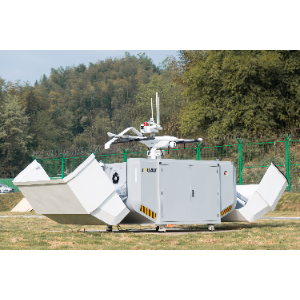
JOUAV VTOL Hangar
The JOUAV VTOL Hangar is a complete drone-in-a-box solution featuring a weatherproof JOS-C800 docking station, a high-performance CW-15V VTOL drone, and the intelligent Jocloud...
View product details →
ARCGine Autonomous Droneport System
Escorts safe flight; Unmanned operation of UAVs, autonomous takeoff and landing, automatic charging and discharging,battery hot replacement,remote monitoring and other all-weather...
View product details →Frequently asked questions
What is a drone hangar and how does it work in a security operation?
A drone hangar is an automated docking station where a UAV is housed, launched, recovered, and re-powered without on-site personnel. The UING UK-01, for example, performs one-button automatic takeoff, automatic recovery, and automatic fast battery swapping and charging, with cloud control and management. In a security operation, this enables scheduled or alarm-triggered aerial patrols of perimeters and critical sites, with live video streamed to your command center.
Can the hangar keep operating during a power or network failure?
Power resilience is documented for the UK-01: it can continue running for 5 hours after hangar power is cut off. For networking, it supports wired, 4G, 5G, and mesh configurations with customization available. For other hangar systems, ask the supplier for the equivalent power-failure and network-resilience specifications; where these are not published, contact us for the datasheet.
What surveillance capability does the UK-01 hangar system provide?
The UK-01's aircraft carries a 30x dual optical payload combining visible light at 1920x1080 resolution and infrared at 640x512 resolution, supporting both daytime and low-light monitoring. The aircraft offers 3 hours of endurance at a 72 km/h economic cruise speed, a 4,500 m practical service ceiling, and an integrated broadband wireless link with optional 50 km, 100 km, or 150 km range.
Is the UK-01 suitable for deployment in Europe?
The available data documents the UK-01's technical capabilities but does not include market-specific regulatory or conformity information. European buyers should request compliance documentation, cloud platform data-handling details, and any relevant operational approval support directly from the supplier. Contact us for the datasheet and compliance documentation before including the system in a tender.
How do I choose between the UK-01 and other hangar systems like the JOUAV VTOL Hangar or ARCGine Droneport?
Compare documented capabilities against your mission profile: aircraft type and endurance, battery handling (the UK-01 uses automatic fast battery swapping and charging, while the ARCGine system documents battery hot replacement), network architecture, weatherproofing, and management platform. The JOUAV solution, for instance, bundles the JOS-C800 weatherproof docking station with a CW-15V VTOL drone and the Jocloud platform for 24/7 all-weather operation. Request full datasheets for each shortlisted system and score them against your operational requirements rather than relying on headline figures.
Need help selecting the right system?
Tell us your mission, payload, and operating environment. Our team will help you compare options and request the right datasheets from verified suppliers.