Choosing an unmanned vehicle for a security or counter-UAS program in 2026 comes down to matching platform class to mission: ground vehicles for sustained site presence, air-ground systems for wide-area patrol, and specialized platforms for fire response or confined-space reconnaissance. This guide walks procurement teams through the categories, selection criteria, trade-offs, and integration questions that matter, using four platforms currently listed on SkyDrone Max as concrete examples: the Jiangsu Huimin HM300 sweeper robot, the New AirSafety Z5 unmanned integrated patrol platform, the Guangdong Weihang tethered firefighting UAV system, and the GUANGZHOU ASSAULTINTELLIGENT LD280 reconnaissance robot. No platform here is ranked as superior; each fits a different operational role, and the data below shows where.
What the Unmanned Vehicle Category Covers for Security Buyers
The Unmanned Vehicle category spans more than drones. For security and counter-UAS programs in North America, it includes unmanned ground vehicles (UGVs), docked drone-in-a-box systems mounted on mobile carriers, tethered aerial platforms, and tracked reconnaissance robots. Each class answers a different operational question. A UGV keeps a persistent presence on the ground; a docked drone system extends observation into low altitude; a tethered platform delivers sustained high-altitude payload capability; a tracked robot goes where wheeled vehicles and personnel cannot safely operate.
Understanding this split is the first step in scoping a purchase. Many buyers start with a single-platform mindset and later discover their security coverage requirements span ground and air. The New AirSafety Z5, for example, was designed around that realization: it integrates ground-based mobile advantages of unmanned vehicles with automated low-altitude operation, linking the two rather than treating them as separate purchases.
Selection Criteria: What to Evaluate Before Shortlisting
Use the following criteria to structure your evaluation. For any specification not published in a vendor's listing, request the datasheet rather than assuming a value.
- Autonomy level and navigation: Confirm the stated autonomy classification and the sensors behind it. The Multi-function Intelligent Robot Sweeper (HM300) is rated for L4-level highly autonomous driving on a self-developed intelligent driving computing platform, combining multi-source fusion perception with an independently controllable software architecture and high-precision maps.
- Obstacle detection and safety sensing: Ask what sensor suite drives obstacle avoidance. The HM300 uses RTK, multi-line lidar, IMU, ultrasonic sensors, and depth cameras to perceive its environment in all directions — a useful benchmark when comparing ground platforms.
- Deployment model: Determine whether the platform is fixed-site, vehicle-mounted, or carried by hand. The Z5 uses customized unmanned vehicles (new energy pickup trucks, all-terrain off-road vehicles) as ground carriers that can install and power DJI Airport 2 or Airport 3 drone docks.
- Endurance and operating envelope: For aerial elements, confirm published figures. The Z5's paired Matrice 4D/4TD drones list up to 47 minutes of endurance and an operation radius of 25 kilometers, with IP56 protection and quick deployment in about 3 minutes.
- Payload and mission-specific capability: Match payload capacity to the task. The tethered firefighting UAV system from Guangdong Weihang carries a payload of 200 to 400 kg and sprays water or Class B foam at up to 20 L/s from a height of 100 m.
- Communications and control architecture: For reconnaissance robots, evaluate the control stack. The LD280 uses an Android embedded system with SDR technology, a super protocol stack, and ultra-clear image transmission with anti-interference design.
- Site environment fit: Match the platform to terrain and conditions — paved campus roads, off-road patrol routes, building interiors, or structures.
The Options Available: Four Platforms, Four Roles
The table below summarizes the four platforms using only their published data. Note how differently each addresses the unmanned vehicle mission space.
| Attribute | HM300 Sweeper | Z5 Patrol Platform | Tethered Firefighting UAV | LD280 Recon Robot |
|---|---|---|---|---|
| Manufacturer | Jiangsu Huimin Traffic Facility Co., Ltd. | New AirSafety | Guangdong Weihang Intelligent Manufacturing Co., Ltd. | GUANGZHOU ASSAULTINTELLIGENT TECHNOLOGY CO., LTD |
| Platform class | Autonomous ground vehicle (L4) | Air-ground integrated patrol system | Ducted-fan tethered aerial system | Tracked reconnaissance robot |
| Core capability | Autonomous outdoor road cleaning with obstacle avoidance | Ground vehicle + DJI Airport dock with Matrice 4D/4TD drones | 200–400 kg payload; up to 20 L/s flow at 100 m height | Dual-motor drive; keymod accessory mounting; SDR image link |
| Notable data points | High-pressure dust suppression; automatic water refill and charging | IP56; up to 47 min endurance; 25 km operation radius; ~3 min deployment | Initial firefighting within 15 minutes; total length under 10 m | Wear-resistant rubber tracks with KEVLAR reinforcement; low-noise operation |
| Typical environment (per vendor data) | Residential areas, parks, squares, parking lots, campuses, industrial parks, scenic spots | Outdoor power-free scenarios; harsh temperatures and strong winds | Fire scenes alongside rescue teams | Buildings, caves, dark rooms and other confined spaces |
Two of these platforms serve security programs directly (the Z5 patrol system and the LD280 reconnaissance robot), while the other two illustrate how adjacent unmanned vehicle roles support site operations: the HM300 automates perimeter and grounds cleaning with autonomous navigation, and the tethered firefighting platform addresses site emergency response. Many North American facility security teams procure across these roles as a portfolio rather than as a single SKU.
Trade-Offs to Weigh in Your Shortlist
- Integrated systems vs. component purchasing: The Z5 bundles a customized ground carrier, a DJI Airport dock, and drones into one collaborative operating system. That reduces integration work but constrains you to the configured components. Buying separately offers flexibility at the cost of your own integration effort.
- Endurance vs. tether: Free-flying docked drones on the Z5 offer a 25 km operation radius with 47-minute endurance. Tethered platforms trade mobility for sustained station-keeping and high payload flow rates — the trade-off behind the Guangdong Weihang system's 20 L/s delivery at 100 m.
- Autonomy vs. operational domain: The HM300's L4 autonomy is designed for defined outdoor road environments such as parking lots and campuses. High autonomy in structured settings does not imply suitability for unstructured or interior spaces, where the tracked, low-noise LD280 is purpose-built.
- Specialization vs. multi-function: The LD280's keymod interface supports standard accessory mounting, giving it task flexibility. The firefighting UAV is highly specialized for one critical mission. Decide whether versatility or depth matters more for your program.
- Power independence: The Z5's ground vehicles can carry large-capacity battery packs and support charging while driving, adapting to outdoor power-free scenarios. If your site lacks fixed charging infrastructure, weigh this capability heavily.
Integration Questions to Ask Vendors
Before issuing a purchase order, put these questions to each shortlisted vendor and document the answers:
- What infrastructure does the platform require on site — charging stations, water refill points, dock mounting bases, or network coverage? The HM300 performs automatic water refill and charging; confirm the site requirements with the vendor for the datasheet.
- How does the platform communicate with existing security systems, and what is the image transmission architecture? For the LD280, ask for details on the SDR link and anti-interference performance beyond the published description.
- What customization is available? The Z5's ground carriers are customized and modified for airport installation and signal linkage — ask whether equivalent customization applies to your fleet vehicles.
- What are the maintenance and redundancy provisions? The tethered firefighting system cites multiple redundancies to prevent secondary harm on site; request the redundancy documentation for the datasheet.
- Which certifications, compliance documentation, and regional regulatory support apply to North American operations? Where a listing does not state certifications, contact us for the datasheet.
Procurement Checklist for Unmanned Vehicle Programs
- Define the mission profile in writing: patrol coverage area, response roles, interior vs. exterior tasks, and whether aerial or ground presence is primary.
- Map the site: surface types, slopes, obstacles, power availability, and any no-fly or restricted zones.
- Shortlist one platform per mission class rather than one overall winner — a patrol system, a confined-space robot, and a response platform are complementary, not interchangeable.
- Verify every published specification you intend to rely on, and request datasheets for anything unstated, including endurance, payload limits, protection ratings, and autonomy boundaries.
- Confirm regulatory pathway for your jurisdiction in North America, including operator licensing and airspace requirements for any aerial element.
- Negotiate support terms: spare parts availability, software update policy, customization lead times, and training.
- Pilot before fleet-wide commitment: run a defined trial on your actual site and score the platform against your written mission profile.
- Plan the operating model: who monitors the platform, who responds to its alerts, and how its data flows into your security operations workflow.
Where to Start
If your program prioritizes automated wide-area patrol with air-ground coordination, begin with the New AirSafety Z5 unmanned integrated patrol platform. If your requirement is autonomous grounds maintenance alongside security operations, review the HM300 multi-function intelligent robot sweeper. For structural emergency response capability, evaluate the Guangdong Weihang tethered firefighting UAV system, and for interior or confined-space reconnaissance, examine the LD280. For any specification not listed above, contact us for the datasheet — and use the checklist before committing budget.

Featured product
Multi-function Intelligent Robot Sweeper
The HM300 multi-functional intelligent robot sweeper independently developed by Jiangsu Huimin Traffic Equipment Co., Ltd. has become a shining star in the cleaning field with its outstanding performance and cutting-edge innovative technology. The HM300 multi-functional intelligent robot cleaner is like a wise...
Products mentioned in this guide

Unmanned integrated patrol platform
This product is an unmanned collaborative operation solution featuring "air-ground integration and intelligent linkage". It utilizes an operating system to integrate the...
View product details →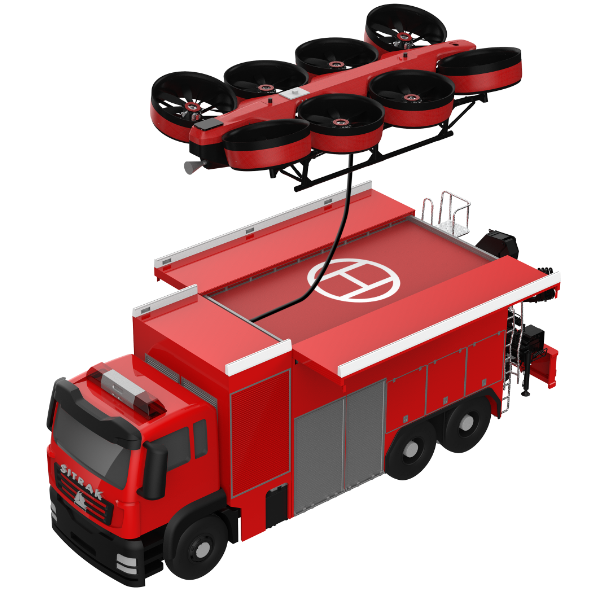
Ducted fan high-altitude tethered fire-fighting UAVs(Unmanned Aerial Vehicle system)
① Strong fire-fighting capability: The payload ranges from 200 to 400kg, and the continuous flow rate of liquid (either water or Class B foam) sprayed at a height of 100m can...
View product details →
LD280 reconnaissance robot
The platform meets the needs of light weight, dual-sided multi-purpose, etc.; equipped with an efficient dual-motor drive system and a lightweight-load body, which greatly...
View product details →Frequently asked questions
What types of unmanned vehicles are relevant to security and counter-UAS programs?
The category includes autonomous ground vehicles such as the HM300 sweeper robot, integrated air-ground patrol systems such as the New AirSafety Z5 with docked DJI drones, tethered aerial platforms such as the Guangdong Weihang firefighting UAV system, and tracked reconnaissance robots such as the LD280. Each addresses a different part of a site security mission.
How autonomous is the HM300 robot sweeper, and how does it navigate safely?
Per the manufacturer, the HM300 has L4-level highly autonomous driving capability on a self-developed intelligent driving computing platform. It combines intelligent control decision-making, multi-source fusion perception, an independently controllable software architecture, and high-precision maps. Safety sensing uses RTK, multi-line lidar, IMU, ultrasonic sensors, and depth cameras for all-direction perception and automatic obstacle avoidance.
Can one unmanned vehicle cover both ground patrol and aerial surveillance?
The New AirSafety Z5 is designed for exactly this: it integrates customized unmanned vehicles (such as new energy pickup trucks or all-terrain off-road vehicles) with DJI Airport 2 or Airport 3 docks and Matrice 4D/4TD drones. The vehicles provide autonomous navigation, obstacle avoidance, mobile power supply, and charging while driving, supporting outdoor power-free scenarios.
What performance figures are published for the tethered firefighting UAV system?
Guangdong Weihang lists a payload range of 200 to 400 kg, a continuous liquid flow rate (water or Class B foam) of up to 20 L/s at a height of 100 m, initial firefighting within 15 minutes of arriving with the rescue team, a total vehicle length under 10 meters, and multiple redundancies for on-site safety. For further specifications, contact us for the datasheet.
Where can I get full specifications for platforms with incomplete public data?
Some listings do not publish every specification, certification, or performance figure. For any detail not shown on the product page — such as certifications, pricing, or test data — contact us for the datasheet, and our team will connect you with the manufacturer's documentation.
Need help selecting the right system?
Tell us your mission, payload, and operating environment. Our team will help you compare options and request the right datasheets from verified suppliers.