A flight controller with FPV system is the component that turns a security or counter-UAS airframe into a mission-capable platform: it fuses gyroscope, accelerometer, magnetic, airspeed, barometric, navigation, and temperature data into a single picture of the aircraft's position, speed, attitude, and heading, then relays that picture to the operator in real time. For security teams running perimeter patrols, site monitoring, or airspace awareness missions, the flight controller determines whether telemetry is trustworthy, whether the aircraft can be integrated with ground stations and payloads, and whether flight data can be stored and reviewed after an incident. This article walks through the workflow, integration considerations, operating constraints, training needs, and procurement questions B2B buyers should address before standardizing on a flight control system.
Why the Flight Controller Sits at the Center of Security UAV Operations
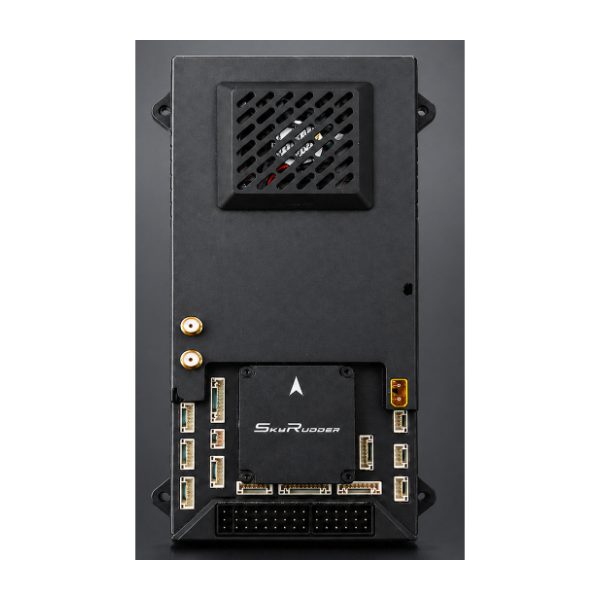
In security and counter-UAS programs, the airframe rarely fails first — the data chain does. If an operator cannot confirm position, heading, or airspeed with confidence, a patrol becomes a liability rather than an asset. That is why procurement teams treat the flight controller with FPV system as the anchor component of the build rather than an accessory. A representative example is the ZDT-FC03 flight control system from Beijing Zhongke Daokong Technology Co., Ltd., which integrates gyroscopes, accelerometers, magnetic sensors, airspeed sensors, barometric altimeters, satellite navigation modules, and thermometers in a single unit. It also includes a high-speed EMMC storage device for user data, which matters for teams that need to retain flight records for incident review or audit.
The ZDT-FC03 adopts dual domestic processors for data processing and computing, and internally integrates a power module that outputs multiple controllable power supplies to drive other control components. For security integrators, that means fewer external power boards to specify, qualify, and stock — a meaningful reduction in bill-of-materials complexity for fleet builds.
The Operational Workflow: From Pre-Mission Check to Post-Mission Review
Security UAV missions follow a repeatable cycle, and the flight controller participates in every phase of it:
- Pre-mission: the operator confirms sensor health — gyroscopes, accelerometers, magnetic sensors, barometric altimeters, and the navigation module — and verifies that stored configuration data on the controller's storage device is current for the site.
- Launch and transit: the controller measures position, speed, attitude, and heading continuously, giving the FPV feed and telemetry stream a consistent reference frame as the aircraft moves to its patrol area.
- On-station monitoring: the operator watches live video and telemetry through the ground control segment, cross-checking flight data against what the camera shows to detect drift, interference, or unexpected behavior.
- Incident response: when an event occurs, command inputs flow through the control link to the flight controller, which translates them into actuator outputs via PWM channels and communicates with payloads and companion systems over serial and CAN bus interfaces.
- Post-mission review: flight data stored on the controller's high-speed EMMC storage supports debriefs, incident documentation, and route optimization for future patrols.
Teams that skip the post-mission review step lose much of the value of an integrated flight control system. Storage on the controller itself — rather than relying solely on a downlink — gives program managers a data trail that survives link interruptions.
Ground Control Segment: Pairing the Controller with the Right Station
The flight controller is only half of the human-machine loop. Security operations centers typically require ground stations with sustained processing power, reliable links, and displays that remain readable in bright conditions. The T50 box-type dual-screen ground station from Chinowing Technology is one example of the ground segment that pairs with flight controllers in this category: it features two 17-inch high-definition screens (1280×1024 resolution, brightness of 1000), an Intel i7 1260P CPU with 32GB of memory and 1TB of storage, an IP53 protection level when the cover is open (IP65 closed), an operating range of -20°C to 60°C, industrial-grade telescopic Hall joysticks, 40ms remote control latency, dual SBUS independent outputs, and a communication link supporting V21/V31/V31pro with transmission distances from 5 to 150 kilometers, plus third-party link support.
When procuring the controller and ground station together, buyers should validate the full chain: link protocol compatibility, control latency, SBUS/UART interface matching, and whether the ground station can power and display everything the mission requires. A controller with abundant serial ports, CAN bus, and PWM outputs — as the ZDT-FC03 provides — gives integrators more room to make these connections without custom adapter hardware.
Integration Considerations for Security and Counter-UAS Fleets
Before committing to a flight controller with FPV system, integration teams should map every interface the mission stack needs. Key questions include:
- Interface budget: How many UART/serial ports, CAN buses, and PWM channels does the platform require for payloads, telemetry, FPV video, and servo control? The KFC100 Flight Control System from Shenzhen Juyingfei Technology, for example, specifies more than 25 interfaces including 12 PWM channels, 1 CAN bus, 1 S.Bus, 2 I2C channels, and 7 UART expansion ports — the kind of explicit interface count buyers should demand from any vendor.
- Sensor redundancy: Does the controller duplicate critical sensors? The KFC100 lists dual accelerometers and gyroscopes (2x ICM-42688-P each) and dual barometers (2x MS5611), which supports fault tolerance in security-critical flight. Contact us for the datasheet on any candidate to confirm its redundancy architecture.
- On-board computing: Some security missions require edge processing alongside flight control. The Integrated flight control and computing board (HD-AFC-6T-3588) from Suzhou HardAus Equipment Technology combines an STM32H753 flight control unit with a domestic RK3588 processor, multi-axis inertial sensors, industrial communication interfaces, and PX4 firmware support, and is compatible with multirotor, VTOL, and fixed-wing platforms.
- Firmware and ecosystem: Confirm which firmware the controller supports and whether your team can maintain, configure, and update it without vendor lock-in.
- Power integration: Check whether the controller includes its own power module with multiple controllable outputs (as the ZDT-FC03 does) or whether external power distribution must be procured separately.
Operating Constraints: Heat, Environment, and Duty Cycles
Middle East deployments impose demanding thermal and environmental conditions on electronics, and security missions often run long duty cycles with little downtime between flights. Buyers should not assume thermal tolerance — they should require it in writing. Where a vendor publishes operating and storage temperature ranges, verify they cover the worst-case conditions at your sites; the KFC100, for instance, specifies an operating temperature range of -20°C to 85°C and storage from -40°C to 85°C. For products where thermal specifications are not published in the materials you have, contact us for the datasheet before shortlisting.
Beyond temperature, teams should budget for: link reliability across the operational area (the T50's 5–150 km transmission range is vendor-published and should be validated against your actual terrain and regulatory limits); battery endurance on the ground segment (the T50 lists a DC 25.2V/30000mAh battery with 5 hours of life when fully charged, with external power as an option); and dust and enclosure protection for ground equipment used at exposed sites. Airframe-level constraints — payload capacity, endurance, and wind tolerance — depend on the platform as a whole, so require integrated system data from the airframe vendor as well.
Training and Crew Readiness
A capable flight controller with FPV system still depends on trained operators. A practical training program for security teams should cover: configuration and sensor calibration procedures for the specific controller model; interpretation of telemetry — position, speed, attitude, and heading — and how each parameter behaves during typical patrol maneuvers; failure recognition, including what degraded sensor or link performance looks like in the FPV feed and ground station displays; data retrieval from on-board storage for post-mission review; and link and ground station operation, including channel management and handover between operators on shift. Procurement teams should ask vendors what documentation, configuration tools, and training support accompany the product, and factor that support into the total cost of ownership. Contact us for details on documentation and support packages for any product listed on the marketplace.
Procurement Checklist and Product Comparison
The table below compares the three flight-control products referenced in this article using only their published specifications. Where a value is not published, it is marked accordingly.
| Attribute | ZDT-FC03 | KFC100 | HD-AFC-6T-3588 |
|---|---|---|---|
| Brand | Beijing Zhongke Daokong Technology | Shenzhen Juyingfei Technology | Suzhou HardAus Equipment Technology |
| Processors | Dual domestic processors | STM32H743 | STM32H753 + domestic RK3588 |
| Sensors | Gyros, accelerometers, magnetic, airspeed, barometric, satellite navigation, thermometer | 2x ICM-42688-P accel/gyro, external compass, 2x MS5611 barometer, optional MS4525DO airspeed | Multi-axis inertial sensors |
| Interfaces | Abundant serial ports, CAN bus, PWM outputs (count not published) | 12 PWM, 1 CAN, 1 S.Bus, 2 I2C, 7 UART, 2 voltage monitoring ports (>25 total) | Industrial communication interfaces (count not published) |
| Storage | High-speed EMMC for user data | Not published — contact us for the datasheet | Not published — contact us for the datasheet |
| Firmware | Not published — contact us for the datasheet | Not published — contact us for the datasheet | Supports PX4 firmware |
| Platform compatibility | Not published — contact us for the datasheet | Swarm and patrol plane control system | Multirotor, VTOL, fixed-wing |
| Operating temperature | Not published — contact us for the datasheet | -20°C to 85°C | Not published — contact us for the datasheet |
Use the following checklist when evaluating any flight controller with FPV system for a security program:
- Confirm the sensor suite covers every measurement your mission plan depends on, and ask for redundancy details in writing.
- Count your required interfaces before you buy, then verify the controller's port inventory against that list.
- Match the ground station and communication link to the controller as a system, including latency and protocol compatibility.
- Verify operating temperature, power behavior, and storage capability against your deployment environment — request datasheets where specifications are not published.
- Clarify firmware support, configuration tooling, documentation, and training availability before signing.
SkyDrone Max lists multiple flight controller options across brands so procurement teams can shortlist against these criteria rather than defaulting to a single vendor. Review the full Flight controller with FPV system category alongside the ZDT-FC03, KFC100, and integrated computing boards to find the configuration that fits your airframe, ground segment, and mission profile.

Featured product
ZDT-FC03 Flight control system
The FC03 flight control integrated system internally integrates various sensors including gyroscopes, accelerometers, magnetic sensors, airspeed sensors, barometric altimeters, satellite navigation modules, and thermometers. It can measure the position, speed, attitude, and heading of the carrier. The system also...
Products mentioned in this guide
Integrated flight control and computing board(3588)
This product is engineered for UAVs and industrial unmanned systems. It integrates STM32H753 flight control unit and domestic RK3588 processor, equipped with multi-axis inertial...
View product details →
KFC100 Flight Control System
KFC100 Flight Control System is a professional Swarm & Patrol plane Control system. The Technical Specifications are as follow. Processor:STM32H743 Sensors Accelerometers...
View product details →
T50 Box-type Dual-screen Ground Station
The T50 box-type dual-screen ground station is a high-performance UAV ground station device, featuring powerful functions and excellent performance. It is equipped with two...
View product details →Frequently asked questions
What does a flight controller with FPV system actually do in a security UAV?
It integrates sensors such as gyroscopes, accelerometers, magnetic sensors, airspeed sensors, barometric altimeters, satellite navigation modules, and thermometers to measure the aircraft's position, speed, attitude, and heading, and it translates operator commands into control outputs. In the ZDT-FC03, for example, a high-speed EMMC storage device retains user flight data for review, and an internal power module drives other control components.
Can the ZDT-FC03 integrate with payloads and ground stations used in counter-UAS operations?
The ZDT-FC03 is equipped with abundant serial ports, CAN bus interfaces, and PWM output interfaces, and its integrated power module can output multiple controllable power supplies to drive other control components. For specific payload or ground station compatibility, including products like the T50 dual-screen ground station, contact us for the datasheet and integration details.
Which flight controller should I choose for edge computing in security missions?
If your missions require on-board data processing alongside flight control, consider an integrated flight control and computing board such as the HD-AFC-6T-3588, which combines an STM32H753 flight control unit with a domestic RK3588 processor, supports PX4 firmware, and is compatible with multirotor, VTOL, and fixed-wing platforms. If your priority is sensor integration and power integration in one unit, the ZDT-FC03 is a relevant example.
Are these flight controllers suitable for high-temperature Middle East deployments?
Temperature suitability must be confirmed per product. The KFC100 publishes an operating temperature range of -20°C to 85°C and storage from -40°C to 85°C. For the ZDT-FC03 and HD-AFC-6T-3588, operating temperature specifications are not published in the available materials — contact us for the datasheet to verify thermal performance before deployment.
What should a procurement team request from vendors before standardizing on a flight controller?
Request the full datasheet covering sensor specifications and redundancy, interface counts, processor architecture, firmware support, operating and storage temperature ranges, power module behavior, storage capacity, and platform compatibility. Also ask about documentation, configuration tools, and training support, and validate the controller together with the ground station and communication link as a complete system.
Need help selecting the right system?
Tell us your mission, payload, and operating environment. Our team will help you compare options and request the right datasheets from verified suppliers.